Sunday, May 11, 2014

Hybrid Writing as Mirror, Canvas, Liberator

Getting from the Ordinary to the Extraordinary: Experimenting with Hybrid Forms in Your Writing.
Writing Workshop with U.S. writer Lisa Taylor
An Gairdín
Portumna, Co Galway
Sunday May 18th
3− 5pm
Numbers limited so BOOK NOW!
Booking with hickeycommunications@gmail.com  0863195603
Workshop will be followed by readings from three Arlen House writers: Geraldine Mills, Lisa Taylor and Alan McMonagle  at 5.30pm in An Gairdín.
Cost : €10 for the afternoon

Breaking Structure: Hybrid Writing as Mirror, Canvas, Liberator 
Lisa C. Taylor
 Borders are becoming blurred all over the world.  Web videos invade our search for the local weather with their pop-up persistence.  Movies experiment with stories that tell the ending first or offer an omniscient narrator in a voiceover.  Hybrid cars transition smoothly between gas and battery power sources.  Likewise, hybrid narratives contain within either a style or a topic that counters the narrative or the style.  Hybrid writers can blend fact and fiction, poetry and prose, memoir and history, or even art, media, dance, or music.  They can choose to write in a nonlinear fashion as Lidia Yuknavich did in her memoir, The Chronology of Water or they can mix subjects as Annie Dillard did in For the Time Being, a mosaic of topics that included travels in China and Mongolia, the teachings of an 18th Century Jewish Mystic, and the drama of rocks, rivers, lichen, and clouds as witnessed by scientists, poets, and painters.  Hybrid writers can break up lines, create a collage-like random association of ideas, morph a character into different incarnations as was done with Bob Dylan in the movie, I’m Not There.  These artistic and commercial creations blend and fragment content as an expressive model and reflection of today’s evolving culture.  In this workshop, you will play with form and content, inventing a new way to represent your own emotional truth.

Lisa C. Taylor's poems show the importance of slowing down and paying attention, of listening to others, of asking what the deepest self feels. Taylor knows that the imagination is the most powerful tool we have for transformation. -Ted Deppe


Sunday, April 27, 2014

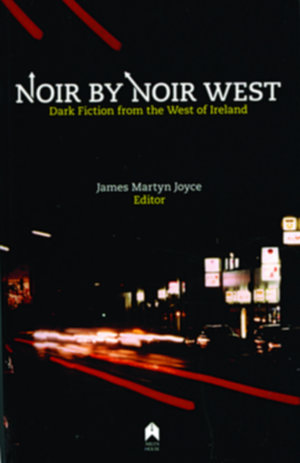
Noir by Noir West


Noir By Noir West - disquieting Galway stories

GALWAY ADVERTISER, 
Noir By Noir West - disquieting Galway stories
How about this for revenge? A man dumps his wife for a younger model. Wife appears quite civilised about it. But just as ex is about to go off on a classy holiday with new model she asks him to check out an old property she is thinking of buying. It’s in an awful state, but she needs him to trip a switch on the meter box in the tiny space under the stairs so she could check the lights on each floor. It will only take him a minute. Its a small space, and she is wearing a tight skirt and hates spiders.
It is the least he could do. He leaves the new model waiting at the airport. He’ll only be a few minutes. But once inside the ‘tiny space’ she slams the door closed, reinforcing it shut. He is trapped ‘ hunkered there, on his knees like a penitent, shouting...’ Hours later he feels water coming in slowly. His clothes are soaked. And then he remembers what she had said: “ Flood plain. The blocked drain outside the door, swollen river, and rain promised for days to come...”
Or the man who loves pike, those fierce looking fish ‘who devours 200 times its size in a lifetime.’ He hates the tourists who come to kill them.‘ I live on the boat Easter to October. Moonlight is the best time on the Corrib. I like to glide in the shadows, pike nuzzling up to the boat. They know me. Beautiful creatures. But tourists come and kill them.
‘There was a fella last year, big German with a belly. Fell off the jetty. I could see the cut above his eye. Kept shouting and clawing at the side of my boat, gasping, trying to say something. Couldn’t make out what. Don’t speak German...’
Or the terrible confrontation between a father and son in Crowes pub on Sea Road. The Kray twins aren’t in it for viciousness! The father, who was sitting at a table with an ice bucket in front of him. He was called Baby Face by Galway girls when he was a teenager. Galway boys knew not to say it. They were the savage Kings of Galway who dealt in all kinds of ‘merchandise’.
Except for the father, the pub was deserted. ‘The Galway Novena was on in the Abbey church.’ The son enters. His three minders follow, and stand to one side. A fierce argument erupts between the father and son. It is evident that the son, at some stage, is going to wipe out the father, but in a dramatic movement the father beats him to it. He suddenly produces a gun from under the table, aims it at the three bodyguards, warning them to freeze. At the same moment he brings a blade down on his son’s left hand and cuts it off. ‘The son screams. He tries to struggle. Blood spurts onto the table. The father grabs the other arm, and cuts off the right hand....He drops both hands into the ice bucket. And arranges them so they point upwards as if in prayer.’
After all, the Novena is on at the Abbey...
Widespread popularity
These stories, written by Geraldine Mills, Gerry Galvin and Séamus Scanlan respectively, are just three of 31 collected by James M Joyce, and gleefully published in a macabre and very entertaining collection Noir By Noir West - Dark Fiction from the West of Ireland, which was launched at the recent Cúirt festival.*
I am not quite sure why many of us enjoy noir or dark fiction/movies or those Scandinavian detective series. There is a difference between ‘horror, and ‘noir’. Monsters and other elements of horror have appeared in storytelling since prehistory, such as Beowulf and The Odyssey. In the 19th century Mary Shelley, Bram Stoker, and Henry James incorporated monsters, vampires and ghosts into their stories, which enjoyed widespread popularity. But noir, or dark fiction, is more subtle, I think, exploring the darker side of human nature without the recourse to total fantasy, such as monsters. The Grimm brothers have been disturbing our children since they first published their German folk tales in 1812. And generations of children love them.
A disturbing story
One of the objectives of this collection is to encourage new talent. Kernan Andrews, in his Im Niemandsland, presents an original twist on World War I. A Jewish soldier, Hans Rubenstein, is fighting in France for Germany. He receives a letter from his brother Emil who is serving the Kaiser in western Russia. Emil is amazed to discover ‘the numerous villages , and even some towns, where the inhabitants are almost entirely Jewish. I hear snatches of Hebrew amidst the Russian and Yiddish.’
He writes that he is ‘ immensely proud to be both Jewish and a German soldier, playing a role, however small, in alleviating the suffering of Russian Jews, one Ashkenazic aiding another.’
The irony is of course that barely 24 years later the Germans came back to round up all those Jews. Millions were murdered. At Babi Yar, a ravine in Kiev, Ukraine, on September 29/30 1941, at least 35,000 men, women, and children were shot in one action.
An equally disturbing story, by Cristina Galvin, is set in a world without beauty; only ‘ boarded up pubs, the once-upon-a-time grocery store with produce still moulding on rusting shelves - hairy orange, wizened turnip, tomatoes gone a-mush with maggots.’ In the streets ‘the smell of fetid matter assaults you and you clasp your belly and heave...’
But into this decaying world, a mysterious blue flamingo comes and nests in a young women’s garden. The woman watches the bird ‘all tension dissolving’ her eyes lit up lantern -like...her heart opens.’
The woman is inspired to act. Putting on her warm clothes she takes to the streets, and the reader follows her, camera-like, as she passes through the rotting city until she comes to a queue of women with small children and babies. They are waiting outside a concrete barracks.
Apparently there is a surfeit of children in the country. The mothers are handing in their babies. We do not know what happens to them, but the women leave ‘buggy-less and weary-looking, and make their way back towards the estate’.
The woman the reader is following manages to enter the barracks, and emerges with a baby hidden under her coat. But she is disturbed by a man running up the street. Frightened she runs down an alley and hides the baby in a wheeliebin.... In a beautiful piece of writing Cristina cleverly allows the reader to enter the story and to take the baby into its care, while ‘with feathers shimmering against the sky’s indomitable grey, the blue flamingo sits.’
NOTES: * Noir by Noir West (has a suitable Alfred Hitchcockian ring about its title), is published by Arlen House, and is on sale in all local bookshops at €17. Dagmar Drabent’s cover design is perfect.
It is dedicated to the late Gerry Galvin, and follows two previous collections: Galway Stories, edited by Lisa Frank( €13), and What’s Not Said, edited by James M Joyce (€13).

Friday, April 25, 2014

What the Dark Becomes


What the Dark Becomes

Injured, the young barn owl pushed its head
into the tree,  trying to hollow out some darkness for itself.

Brightness blinding, its knitting needle beak clicked away
until I put it in a shoebox under the refuge of hedge.

All day it ate nothing, drank nothing
just blinked its yoke-yellow eye at me.

Listening for the slow sounding of dusk,
I carried the box to the hill, turned it on its side.

The fledging bird, dazed, flopped out, stumbled
across the grass, up, then down again.

Maybe its instinct measured the leaving of light 
or wisdom to some silent homing call

because it gave a little run, a flap of wing,
flew back into the dark it swept out of me.


Sunday, April 20, 2014

Reading at Cúírt Literary Brunch

The Cúirt Literary Brunch was certainly a very special morning in Vina Mara last Sunday where I shared the platform with Geraldine Mitchell, a very, fine poet whose work I greatly admire and Edward O'Dwyer whose debut poetry collection  is one to watch out for. I read Centre of a Small Hell from my third short story collection Hellkite (Arlen House). My gratitude to Alan McMonagle who gave such a considered introduction to my reading that I asked to publish some of it here. He kindly agreed.  If you are not already familiar with Alan's compelling short fiction go and get a copy of  Liar Liar (WordsontheStreet) or Psychotic Episodes (Arlen House, 2013)


Alan McMonagle
Thanks Alan for the following:

Finn MacCumhaill shows up in the fruit and veg aisle of a Dublin supermarket. The Angel Gabriel takes a shine to a trampoline set up in a moonlit, country garden. We witness an adulterous man's metamorphosis into a pig. While another man, for whatever reason, takes one step too many and finds himself locked away in a room of little ease.
     These are just some of the scenarios offered by Geraldine Mills in her third collection of stories, Hellkite, a collection courageously peopled by a cast of mischievous, indifferent, cruel, and indeed hellish women.

     Men are in trouble in these stories. They are betrayed, pecked at, lied to, stowed away, literally put on leashes. Indeed, upon reading the title story in this new collection I can safely say I am never going to look at a cubbyhole the same way again. And I now have a new mantra. Ladies First... 
     When I read Geraldine's stories many names come to mind: the earthiness of Flannery O'Connor, the comic surrealism of the great Uruguayan Eduardo Galeano, the imagery of Pauline Bewick. To paraphrase a well-known boxer, Geraldine's prose floats like a butterfly and stings like a bee. Geraldine takes risks in her writing. And like any self-respecting risk-taker the acknowledgement implicit here is that things may not always go according to plan, the writing itself becomes a high-wire act, a leap of faith and ultimately its own reward. 
     Listen to some of these opening lines. A man fell out of the sky and into my garden... All through the day the geckos come, flicking up the walls, their tails writing dark all over the plaster...With the splutter of the chainsaw the birds rose from the trees like black letters into the blue page of the sky...and one I really like...When it comes to women I'm as helpless as a cow in quicksand.
...notice the avian imagery, that stretching of reality, the mythical atmosphere we are instantly immersed in, the almost casual surrealism of it all, the playfulness and of course the foreboding.   
     Geraldine has said in interview that It’s not enough to have a good story if the writing doesn’t stand up and equally no good if you have well constructed sentences and no plot. The alchemy is in the melding of the two. 
     And so let me now invite an alchemist extraordinaire to the platform.


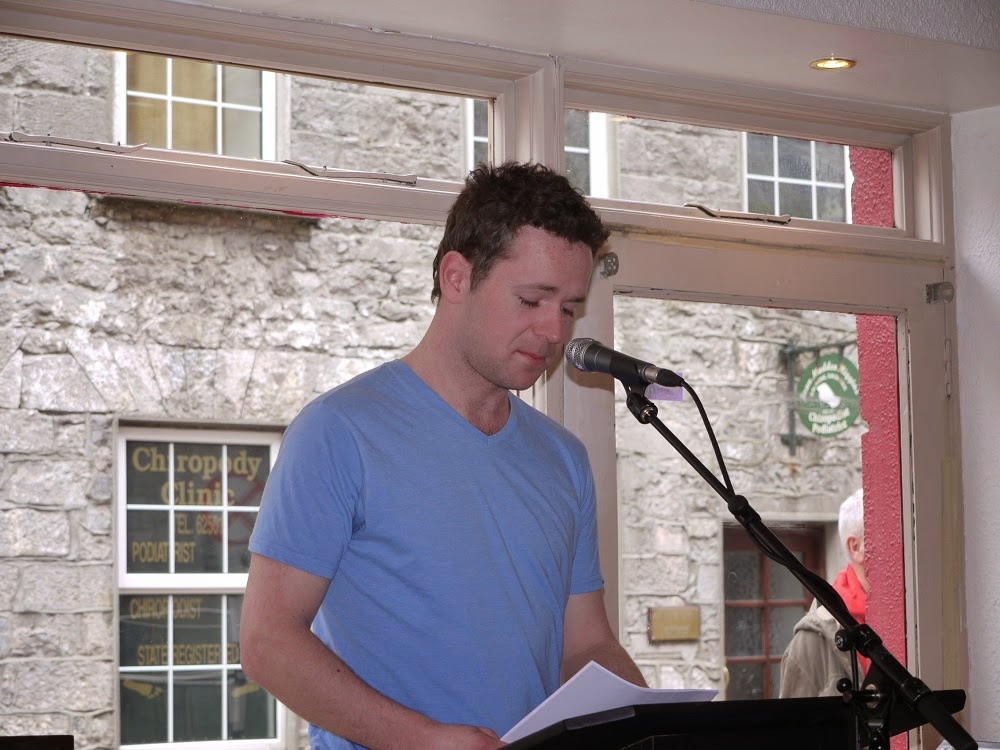
                                                                Getting into the reading voice

Geraldine Mitchell

Edward O'Dwyer


Wednesday, March 19, 2014

In Conversation with Valerie Sirr


I’ve admired Geraldine Mill’s work for a long time now. I first came across her writing when her story ‘Lick of the Lizard’ won the millennium Hennessy New Irish writer award. Her winning story became the title story for her debut collection of short fiction published by Arlen House in 2005. I reviewed that collection here.
Hellkite, Geraldine’s third short fiction collection published recently by Arlen House, is a powerful and original work that explores the goodness of men, and the cruelty, sometimes indifferent, sometimes hellish, of women to men. There’s a lively, imaginative playfulness in these stories and the abandoning wife in the opening story is further developed in the final story, which allows an exploration of the humanity of the hellkite and frames the collection beautifully. Below, in this review/interview, we explore the many strengths of Geraldine’s collection. 
Valerie Sirr: The idea of a collection of hellkites for a book of short fiction is wonderfully inventive. How did the idea come to you? Did you come across the word somewhere, an image? Was it an emerging theme in your work?
Geraldine Mills: The collection didn’t start out like that at all. There was never a moment when I said I was going to write a book about cruel people or about men who have been cruelly treated by women. Like most writers, it is not the way I work. I go with the gut instinct of what is chipping away at my imagination; what will not give me peace until I start to give it some attention; until the image begins to hold. 
Thank you Valerie for the time you put into preparing the questions for our interview. I loved getting stuck into those questions that make me consider the craft and why I write.  Check out Valerie Sirr's Blog for the the full interview. 

Sunday, March 16, 2014

Update on Hellkite


It is always very heartening when people take time to write to you to tell  you how much they are enjoying your book. Letters and emails have been coming in from the most unlikely places around the world  to say they ordered Hellkite from Kenny's and have been reading stories to one another or discussing the different themes in their writing circles.

 It is also rewarding when the reader gets it; knows what you are trying to do in the stories and see the patterns and nuances within the different ones. The limited-edition hardback is almost sold out but the paperback is still available in  good bookshops. Here is another extract from:

The Devil’s Dye
First Eliza must chase Marisolle from the barn. That girl with her pangolin eyes and slouching walk carries bad spirits in her pocket and every time she is within bleeding distance things start to unhappen. She is best sent off to the fields at the end of the farm where she can sit in the blistering heat and hex no one, float around the corn shucks; let the duende of her mind dance like a mad thing – if that’s what a goblin does – but not here. Not here in the barn where Eliza knows everything depends on it, the plantation’s livelihood, their house, their mother’s nervous disposition.
            Eliza gathers as many bundles of the plant into her arms as she can manage and piles them into the big expanse of vat that squats on the dusty floor.  She orders the servants to carry buckets of water from the cistern to the big zinc bath, pour. The colour a  dirty yellow, the odour so offensive it chokes the whole space around them and they have to  pull their aprons over their mouths, their noses as they continue to bring more buckets to its rim.
‘Go now. Leave me.’ she says. ‘Go about your other chores and leave me, for this is my task only.’
She waits until Nathanial and Amos pull the big door closed and apart from the light that comes through the slats of the windows and the motes that scatter out around her, there is just herself and the putrid container of mud liquid before her.


Wednesday, February 19, 2014

Precipitation


This poem was recently published in Southernmost Point Guest House (Pretend Genius Press)

Precipitation


I carry a mountain of cloud on my shoulders,
patches of fog drizzle along strands of my hair,
I open the window and rain tumbles onto my head,
thunder hangs its coat behind the door.

The weather forecaster speaks like Sylvia Plath,
tongueful of words hailstone-sharp,
clipped as the north wind that fells elms.
My mind has visibility greater than ten miles.

Indigo nimbus, cumulonimbus, violet storms
shatter the bee box under the bed,
wings, limp from damp, swarm
headlong onto the floor, buzzing.


Photo courtesy of Peter Moore